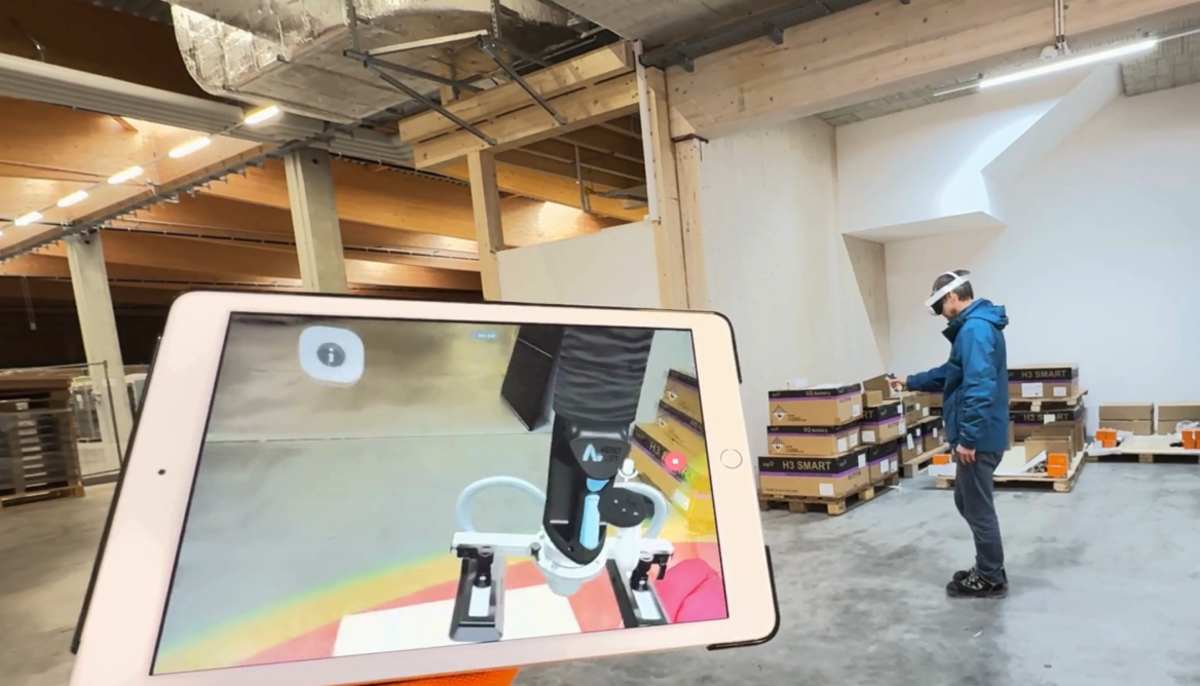
How will a planned vacuum handling solution actually work in the room later on? Are movement sequences, reach and accessibility suitable for the production environment? And can potential challenges be identified before the system is implemented?
When planning complex vacuum handling solutions, far-reaching decisions often have to be made at an early stage of the project. At the same time, often only drawings or conceptual designs are available at this stage. However, spatial conditions, movement sequences and integration into existing production environments can only be derived from these to a limited extent.
Together with partners from industry and research, AERO-LIFT is meeting this challenge with an innovative approach: by using virtual reality, technical solutions can be experienced realistically even before they are implemented. This creates a new form of consultation in which planned systems can not only be viewed, but also virtually experienced and jointly evaluated.
The solution was developed as part of the "VR-Chain" research project funded by the German Federal Ministry of Research, Technology and Space. The project focused on the collaborative use of virtual reality along value chains. The aim was to develop new forms of collaboration across company boundaries and to make complex coordination processes more efficient.
The VR solution was developed and implemented together with partners from industry and research over the course of a multi-year project. In addition to AERO-LIFT, the project participants included VETTER Krantechnik GmbH, the Lightshape agency and scientific institutions such as the ISF Munich and the University of Bremen.
At AERO-LIFT, the VR application is now being specifically integrated into the inquiry and quotation process. After the technical analysis, a digital 3D model of the planned system is first created, which is then transferred to a virtual environment. There, customers, sales and design can work together on the solution. Systems can be inspected on a real scale, different variants can be compared and work processes can be reproduced realistically.
"This allows us to create a basis for decision-making that goes far beyond traditional drawings. Our customers can experience their future system before it is even realized," says Tobias Pauli, Managing Director of AERO-LIFT.
A key advantage is the collaborative approach: several project participants can work simultaneously in the virtual environment and coordinate adjustments directly. Positioning can be optimized, ranges can be checked and potential interference contours can be identified at an early stage. Ergonomic aspects and accessibility can also be evaluated immediately - without the need for time-consuming physical prototypes.
Early visualization significantly reduces the coordination effort in later project phases. Decisions are more informed, misunderstandings are minimized and iteration loops are shortened. For AERO-LIFT, this means more efficient project management - for customers, above all, more transparency and certainty in planning.
Watch the results video of the VR-Chain project here: https://youtu.be/KRuMzk2YK7w?si=4_KJh8eGaVAsOnsh


